- Table of Contents
- What “Value Density” Means on TikTok
- Why TikTok Prioritizes Dense Content
- Value Density vs Speed
- How TikTok Evaluates High-Value Videos
- The Core Components of High Value Density
- Examples of Value-Dense TikToks
- How to Increase Value Density Without Overloading
- Common Value Density Mistakes
- How Reachism Approaches Value Density
- FAQs
- Conclusion
- Further Readings
On TikTok, attention isn’t scarce time is.
In 2025, TikTok doesn’t reward creators who simply stop the scroll. It rewards creators who justify every second a viewer spends watching. That’s where value density comes in.
Value density is the amount of useful, meaningful, or emotionally resonant information delivered per second of video. The higher the density, the stronger the retention, rewatches, and long-term distribution.
This article breaks down what TikTok value density really means, why it matters more than ever, and how to design videos that feel worth watching and rewatching.
Table of Contents
What “Value Density” Means on TikTok
Why TikTok Prioritizes Dense Content
Value Density vs Speed (They’re Not the Same)
How TikTok Measures High-Value Videos
The Core Components of High Value Density
Examples of Value-Dense TikToks
How to Increase Value Density Without Overloading
Common Mistakes Creators Make
How Reachism Approaches Value-Dense Content
FAQs
Conclusion
What “Value Density” Means on TikTok
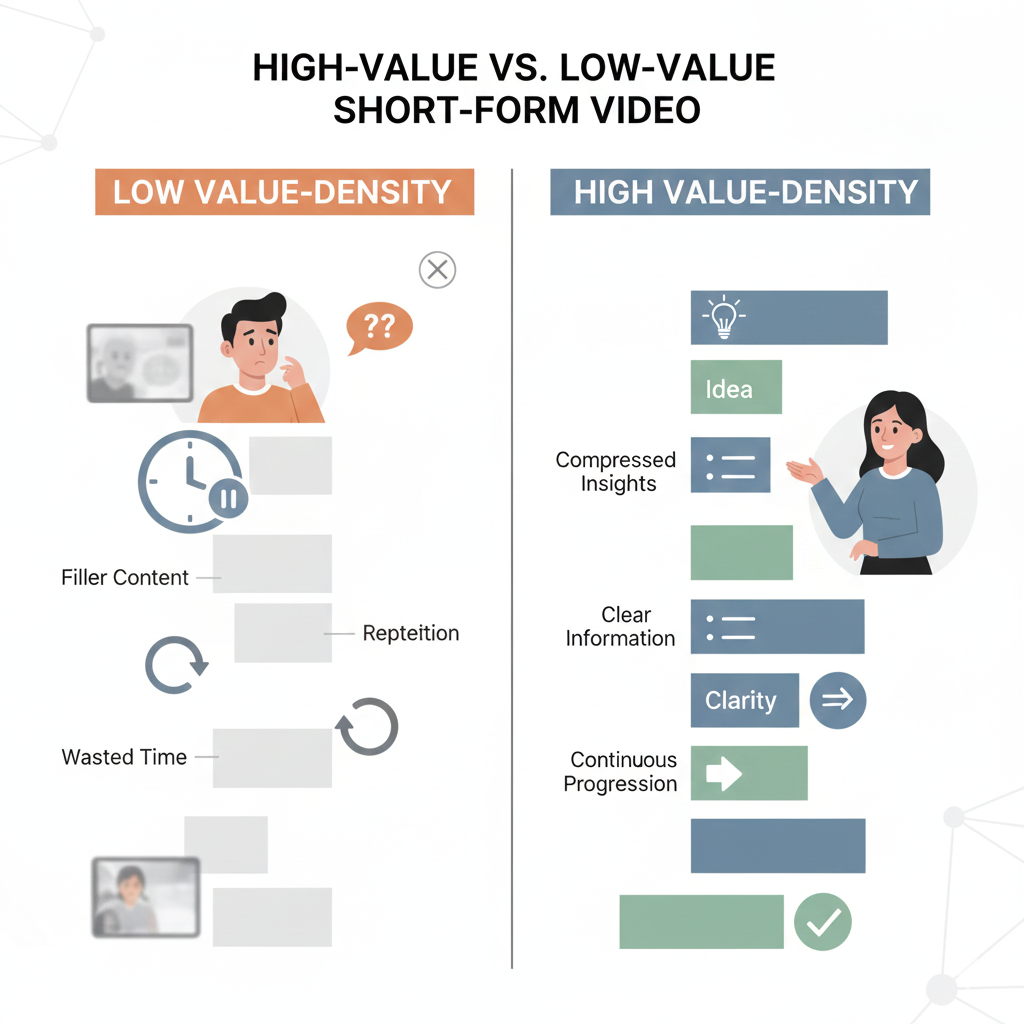
Value density isn’t about talking fast or cramming ideas together. It’s about reducing wasted seconds.
A high value-density TikTok:
Delivers insight quickly
Avoids unnecessary setup
Makes each moment feel intentional
Respects the viewer’s time
Low value-density content may still be entertaining, but it often includes pauses, repetition, vague framing, or filler that weakens retention.
TikTok rewards content that earns attention, not demands it.

Why TikTok Prioritizes Dense Content
TikTok’s recommendation system is built around viewer satisfaction.
It measures:
Watch time relative to video length
Completion rate
Rewatches
Engagement after watching
High value-density videos consistently perform better on all four metrics. Viewers stay longer, rewatch to catch details, and engage because the content feels rewarding.
From the platform’s perspective, dense content keeps users on TikTok longer which is exactly what the algorithm is designed to optimize.
Value Density vs Speed
Fast content is not always dense content.
Many creators confuse:
Talking faster
Cutting aggressively
Adding captions everywhere
With actual value density.
True value density comes from:
Clear ideas
Logical flow
Purposeful pacing
Eliminating redundancy
A calm, well-structured TikTok can be far denser than a chaotic one.
How TikTok Evaluates High-Value Videos
TikTok doesn’t “understand” value the way humans do it infers it through behavior.
High value-density videos often show:
Strong retention in the first 3 seconds
Minimal drop-offs mid-video
Above-average completion rates
Frequent rewatches
When these signals repeat across different audiences, TikTok scales distribution.
Value density turns one good performance into consistent reach.
The Core Components of High Value Density
Clarity
Dense content is clear content.
High-performing TikToks:
Establish context immediately
Avoid vague openings
Get to the point quickly
Confusion kills density.
Relevance
If the content isn’t relevant, density doesn’t matter.
Value-dense videos:
Speak directly to a specific audience
Solve a recognizable problem
Match viewer intent
Relevance ensures the value actually lands.
Compression
Compression is the skill of saying more with less.
This means:
Removing unnecessary words
Cutting redundant explanations
Showing instead of telling
Compression increases density without overwhelming viewers.
Progression
Each second should move the idea forward.
High value-density TikToks:
Build logically
Avoid looping the same point
Deliver new information or perspective
Stagnation causes drop-offs.
Examples of Value-Dense TikToks
Value density shows up across niches:
Education: Clear frameworks explained with real examples
Business: One insight per video, not five vague tips
Creators: Process breakdowns instead of motivational filler
Entertainment: Tight setups with strong payoffs
Different niches, same principle: no wasted seconds.
How to Increase Value Density Without Overloading
High density doesn’t mean overwhelming viewers.
To balance:
Focus on one core idea per video
Use visual cues to support understanding
Let silence exist when it adds clarity
Design for rewatchability
A video that’s slightly too dense is better than one that’s too thin.
Common Value Density Mistakes
Creators often reduce density by:
Over-explaining simple points
Adding long intros
Repeating the hook mid-video
Using trends that don’t add meaning
Prioritizing style over substance
Density drops when content serves the creator’s ego instead of the viewer.
How Reachism Approaches Value Density
At Reachism, value density is a core principle.
We help creators:
Identify what actually matters to their audience
Compress insights without losing clarity
Design content that earns retention naturally
Build systems where every video compounds growth
Dense content doesn’t just perform better it builds trust faster.
FAQs
Does value density mean shorter videos?
Not always. Longer videos can be dense if every second adds value.
Can entertainment content be value-dense?
Yes. Emotional payoff counts as value when it’s intentional.
Will dense content hurt accessibility?
No, when clarity and structure are prioritized.
Conclusion
On TikTok, attention is earned second by second.
Creators who understand value density stop chasing hooks and start designing content that respects the viewer’s time. In a platform flooded with noise, dense content feels refreshing and TikTok rewards it accordingly.
Say more. Waste less.
That’s how reach compounds.